Place Your First Exchange Bet, Back or Lay, Then Work Out the Cover
A back bet risks what you stake. A lay bet risks what the backer would win. The odds decide the gap.
Back and lay betting comes down to which side of a price you take. A back bet wins if the selection wins; a lay bet wins if it does not. On a betting exchange you can place either one, because backers and layers face each other on the same market. A back risks its stake. A lay risks the backer's stake multiplied by (odds - 1), which Orbit's slip calls Liability: at 5.00, a lay that collects £20 risks £80. Below you will find a first bet on Orbit Exchange in five steps, the liability at five prices, and a calculator that covers a back bet with a lay.
Two colours, two sides
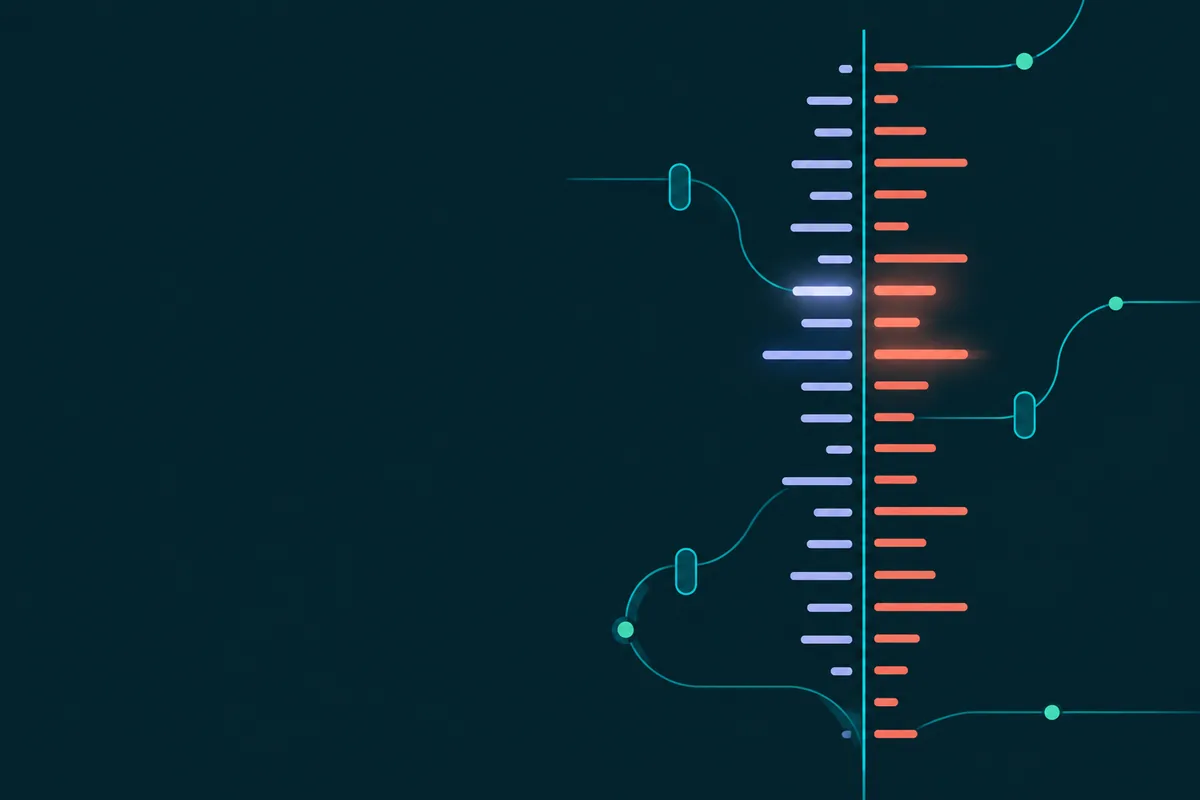
Blue to back. Pink to lay.
That is the whole screen. The blue cell beside a selection is the price to bet that it wins; Orbit's interface describes that column as "a price to bet for something to happen", the way a sportsbook would. The pink cell is the other seat. There, Orbit's interface says, "you can accept other people's bets by betting against them". Backers and layers face each other across those two colours. Beside the prices runs a Matched column; the short answers at the foot of the page say what it counts.
The exchange betting guide covers how the market makes those matches. This page starts at the click.
Your first bet, step by step
Five steps, in the order the slip asks for them. The labels are the ones Orbit's interface uses; the Orbit Exchange page describes the exchange around them.
Choose the price
Click the blue price next to a selection to back it, or the pink price to lay it. A lay answers a backer: you take the bet they want to make. Every price on this page is written as decimal odds, and the odds converter turns fractional or American prices into them. The best-odds page covers choosing between prices at different places.
Enter your stake
Type the amount. A back's potential profit is stake × (odds - 1). On a lay, your potential profit is the Backer's Stake shown on the slip, the money the backer puts in.
Read Liability before anything else
Ask one question first: what do I pay out if this goes wrong? On a back, the stake. On a lay, Liability: in Orbit's interface, "the total risk of your bets on that market in your worst case scenario". Total Liability adds the Charge, the slip's word for commission.
Decide whether to confirm
The slip has a tick box, Confirm bets before placement / removal. Tick it and Orbit asks you to confirm each bet before it is placed or removed.
Place it, then read the status
Press Place Bets. You now hold an offer, and Orbit's interface says it can come back unmatched, partially matched or matched in full. An offer first. A bet only once someone takes it: "Until your bet offer is matched by someone else, you do not yet have a bet." The same interface says unmatched offers stay in the market until you cancel them, and that sometimes you have to change the odds or the stake to get a match. If nobody matches the offer before the market closes, the money comes back. The status is on My Bets.
What a lay risks at each price
Take a lay that collects £20 if the selection does not win. The £20 never changes. The figure you pay out if the selection wins does, because it is the backer's stake times (odds - 1), and the price is the only thing that moves.
Every bar shares one scale. The stake collected is £20 in each row; only the price changes.
Show the data table
| Decimal odds | Backer's stake you collect | Liability |
|---|---|---|
| 1.50 | £20.00 | £10.00 |
| 2.00 | £20.00 | £20.00 |
| 3.00 | £20.00 | £40.00 |
| 5.00 | £20.00 | £80.00 |
| 10.00 | £20.00 | £180.00 |
At 2.00 the two numbers meet: £20 collected, £20 at risk. Shorter than that, the liability is the smaller figure; longer, the larger. Orbit's interface puts it in one line: "The shorter the price you wish to lay, the less money you have to risk compared to your potential reward."
The backer's stake is not your risk
The Backer's Stake is what you collect if the selection does not win, and it is £20 at every price. Liability is what you pay if it wins, and at 10.00 it is nine times the stake collected.
Back and lay calculator
Three modes: a back, a lay, or a back covered later by a lay. It opens on the cover, with the numbers of the next section.
Cover calculator
Enter one bet and see what it pays, what it risks and what it is worth once commission is out.
Example shown: back 30 at 4.20, then lay at 3.60 with 3% commission. Both bets sit on the same exchange. Prices move and a lay can stay partly unmatched, so read the figures as arithmetic.
The 3% is only the value the box opens on. Type the rate your broker announces. The commission page shows how the charge is worked out.
Back first, lay later
Imagine a back of £30 at 4.20 on Tuesday and a price of 3.60 by Friday. A lay of £35 at 3.60, matched in full, leaves +£5 whichever way the match goes, before commission. One extra bet, on the same exchange.
The £35 is not a guess. It is the back stake times the back odds, divided by the lay odds: 30 × 4.20 / 3.60. The lay's liability is then 35 × (3.60 - 1).
- Lay stake that evens the two outcomes
- £35.00
- Liability of that lay
- £91.00
- Selection wins: the back pays £96.00, the lay costs £91.00
- +£5.00
- Selection does not win: the back loses £30.00, the lay pays £35.00
- +£5.00
Commission comes off once, from the profit on the market, so it trims both outcomes by the same slice and the £35 does not change with the rate. At the calculator's opening rate of 3%, £0.15 comes off and +£4.85 remains (the main exchange guide has the reasoning). Both bets must sit on the same exchange for the sums to hold. Orbit's interface describes the opposite-bet move as a way to "minimise your losses", and calls laying first and backing the same selection later in play trading.
Orbit also has a one-click version of the cover, called Cash Out. Its Cash Out page describes an icon on the markets where Cash Out is available: one click cashes out every bet you hold on that market, to take a profit or limit a loss before the event ends. The same page warns that the icon can be missing when there is little money in the market, that the amount is not guaranteed because it rests on live prices (you can receive more than shown, or the Cash Out can fail or fill only in part), and that any profit on the market is paid when the market is settled.
When the result is not +£5
That figure belongs to one price and one fill. Three ways it changes:
- A higher lay price. Cover the same £30 at 4.20 with a lay at 5.00 and the even stake is 30 × 4.20 / 5.00 = £25.20, with a liability of £100.80. The selection wins: £96.00 less £100.80 is -£4.80. It loses: -£30.00 plus £25.20 is -£4.80. A loss of £4.80 either way, and the £96.00 win gone too.
- A lay that is only partly matched. The unmatched part is an offer, not yet a bet, so the position stays uneven until a backer takes the rest. Depth decides how much a market takes at one price (the liquidity page shows how to read it), and the page on stakes without limits separates depth from the caps brokers write into their terms.
- A price that never arrives. A cover is arithmetic on a price that exists, not a forecast of one that has not arrived.
Commission, finally, only ever comes off a profit, so the 5.00 case pays none.
Common mistakes when laying a bet
Five wrong turns, each tied to a line in Orbit's interface or its published exchange rules.
- Reading the stake box as the risk. The Backer's Stake is what you win. Liability, what you pay if the selection wins, is the figure to read, and the chart above shows how fast it grows with the price. Total Liability adds the Charge and is, in Orbit's words, "the total amount you could lose".
- Forgetting the draw. A lay on a team is not a bet on the other team. Orbit's own example lays Brazil at 3, and that lay wins if Brazil lose or draw.
- Treating an offer as a bet. Until a backer takes it, a lay is an offer. A cover worked out on the full stake assumes a lay that may be only partly matched (the cover above has the sums). In a market scheduled to turn in play, unmatched bets are cancelled at that moment unless the bet carries the At In-Play: Keep option.
- Expecting a lay offer to survive a withdrawal. Each horse is given a reduction factor, a percentage based on a forecast price. When a non-runner is removed from a race (late withdrawals follow a separate rule), the rules cancel all unmatched lay offers on the other horses in that market if the non-runner's factor is 2.5% or more in the win market, or 4.0% or more in the place market. Offers carrying At In-Play: Keep are not cancelled; their lay odds are reduced in proportion.
- Assuming the market will pause. The rules say Orbit aims to use reasonable endeavours to suspend an in-play market at the start and the end of the event, does not guarantee that it will, and makes customers responsible for managing their in-play bets at all times. A picture that some broadcasters describe as live can be delayed or pre-recorded.
Back or lay: which side suits you
Back
- Risks the stake and nothing more.
- Potential profit is stake × (odds - 1).
- Becomes a bet only when a layer accepts the price.
Best for: A first bet on an exchange, or any bet where you want the worst case to be a number you typed.
Not ideal if: You need the bet in place at once: a back is only an offer until a layer takes it.
Lay
- Collects the backer's stake if the selection does not win.
- Risks Liability, which is stake × (odds - 1) and grows with the price.
- Becomes a bet only when a backer accepts the price.
Best for: Taking the other side of a selection, or undoing an earlier back with its opposite.
Not ideal if: You size a bet by the stake alone, or the price is long: at 10.00 Liability is nine times what you collect.
Short answers
What is lay betting?
Taking the other seat. A backer says the selection will win; you accept that bet. If the selection does not win, a draw included, you collect the backer's stake. If it wins, you pay the backer's winnings, and that amount is your Liability.
Can I lose more than my stake?
On a back, no. On a lay, yes, if by stake you mean the amount you collect. A lay that collects £25 at 8.00 carries a liability of £175.00 (25 × 7). The slip shows Liability before you press Place Bets.
What is the Matched column?
Orbit's interface says the bets in that column were "accepted/matched by customers with opposing opinions on this market". It counts what has been accepted, so an offer nobody has taken is not in it.
Is this matched betting?
No: matched betting is a separate subject that happens to use the same two bets. This page covers a back and a lay on an exchange. Arbitrage is another subject again.
Reality check
A lay can cost several times what it pays, and a cover only settles the sums at today's prices. Most bettors lose over time; an edge is not a win.
Keep stakes and liabilities to an amount you would not miss. The tools for staying in control are one page away.
Getting onto the exchange
Everything above sits behind a broker login, and four brokers open the exchange. Which of the four ways in suits you is the place to start. The broker comparison sets tools, first deposits and ID checks side by side, and the sign-up page covers the form. A broker account also reaches other bookmakers and exchanges; the broker overview lists them. Still choosing? Start from the front page.